
WDC climate change journey – my address to the Bay of Plenty Mayoral Forum

Thank you for the opportunity to be with you today to share some of our story about our climate change journey.

I’m not going to spend a lot of time with graphs and numbers. That is pretty dull conversation unless you’re a specialist and those are easily available from our website or by contacting our staff, who are all very keen to work with and support other councils. I thought it would be more interesting and helpful to talk about the human dynamics that shaped our journey.

Prior to 2016 if you looked at the WDC website you wouldn’t have seen anything about climate change. A search might have turned up a reference at the back of a planning document but there was no evidence that the council as an organisation understood the implications of climate change or that it was thinking strategically about how to either reduce local emissions or adapt to the climatic and ecosystem changes that are already baked in.

The problem, frankly, was political. There were a number of staff that were intensely interested in the issue with a base of knowledge and skill to work from, but there was a lack of understanding or will at the political level. Staff had developed off their own bat a sustainability strategy but it went nowhere.

Whakatāne District Council’s journey with Climate Change is, more than anything, a story about the power of unleashing talented staff on a challenging problem.

How we began

The journey began almost informally in the last term of council. A steering group was set up with hazy mandate, but it comprised senior staff at tiers 2 and 3 who put their hand up for it, and I was invited to chair. We brought in people from across the organisation, and this has been one of the features to this day, that we have taken a whole of organisation approach, recognising that all of our areas of activity have a part of play.

We also had a project group, that allowed staff at a lower level in the organisation to be involved and input into the program.

We spent a bit of time trying to define our understanding of the issue. One of the difficulties is the high levels of uncertainty. We know that we are warming the planet and we understand in broad terms some of what that means, but we do not know where the tipping points are, or exactly what the implications will be at a very local level. In fact I think one of the responsibilities of civic organisations like councils is to help our communities understand as best we can what the local effects will be, so they can start to make better decisions as they plan and go forward.

Because of that uncertainty it is important we take an adaptive approach – dynamic adaptive pathways they call it – where we try to make decisions that leave options open for the future as much as possible. So we decided that we needed to start with developing the principles that would inform decision-making.

At the same time, because of the lack of political leadership from Wellington at that time, LGNZ and some TAs were picking up the slack. The Mayoral Declaration on Climate Change, which was signed by our then Mayor Tony Bonne, was quite helpful in articulating some of the principles that we adapted into our draft climate change principles.

The other influential event was the Edgecumbe floods, which I think sharpened people’s thinking around what climate change might mean for a district like ours – generally low lying, at risk of sea level rise and inundation, with large areas of flood prone land protected by stopbanks. That’s without mentioning the fire risk with our large areas of plantation pine forest.

We joined up with the CEMARS programme (not known as Toitū) which helped us to understand our carbon equivalent profile
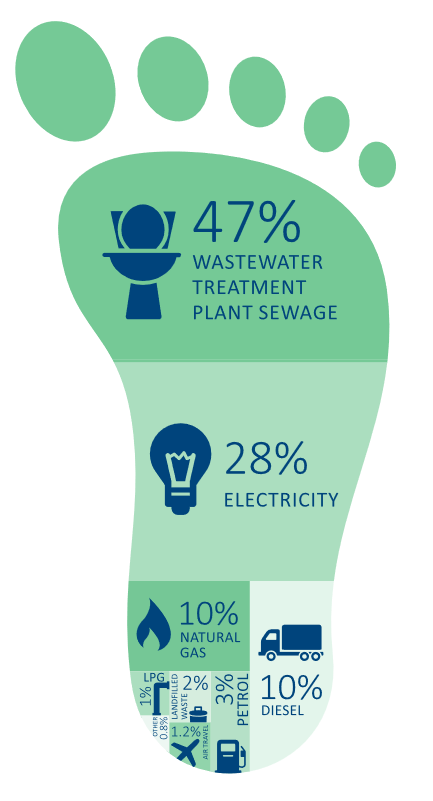
And we developed a set of 6 principles

1. We will act now.

This included commitments to emissions reduction, showing leadership in our community, and to change how we operate as an organisation

2. We will protect the environment
Which included some specific commitments around transport, resource use, procurement, biodiversity and circular economies

3. We will acknowledge those most affected
Recognising that the impacts of climate fall disproportionately on the poor, and often on the people who have least contributed to it

4. We will think long term
Acknowledging that climate change impact projections often stop at an arbitrary year but the impacts will continue to grow for centuries

5. We will learn
Recognising different knowledge bases, including positivist science, mātauranga māori and local knowledge. It is important to stay abreast of changing understandings and we have rolled out an education program among staff and councillors to get people onto the same level of understanding. We have also invested in sending key people to advanced training and education.

6. We will be part of the solution
In which we commit to working collaboratively with stakeholders in our communities, with other local authorities, and on a national and internation basis.

We took our climate change principles to our council, which signed them off for consultation. We engaged fairly deeply and got a very good response, perhaps especially from young people. We used our community engagement to gauge what our communities knew about climate change, understand where they got their information from and identify what they saw as trusted sources of information. While we had a small but significant minority of people who were still locked in denialism about climate change, the overwhelming response was enthusiasm for council to try to grapple with this stuff and a clear message to be stronger in our approach.

This term of the council the Strategy and Policy Committee, which I chair, has been given a specific delegation around climate change, and has supported the development of a set of strategies, targets and action plans.


Again these went out to our community for feedback and again the general response has been for us to be more ambitious.

As part of the work towards implementing our action plans we have sought outside advice. We have used EMSOL to do an energy audit, and continue to consult with them. There hs been a lot of interest in solar PV on council buildings, which avoid having to invest in a lot of battery storage because the energy is used during the day as it is produced. Although our civic centre refurbishment will include some PV as a showpiece for the community, we buy our energy at such a good rate, and most NZ energy is renewable anyway, that the business case is not as compelling as less visible changes, such as an energy management system. There are many relatively small actions that can be taken which pay for the investment within 5 or so years. Who would not invest in a 20% return on investment?

We also listen to the community, because there is enormous expertise available if we do. For example one general manager was really keen on solar for our swimming pool. It took a sharp eyed enthusiast to recognise that this would increase emissions because they were least productive when we most needed the heat, and so would rely on gas back up during winter. An energy efficient heat pump turned out to be a better solution in terms of overall emissions, and cost.

In fact our swimming pool has been the real star of our organisation, with the manager really taking on board the recommendations from EMSOL and implementing a series of changes that have massively reduced the carbon emissions from our swimming pools.

The other thing I’ll mention is our fleet management advice, which has given us a process for changing out ICE (internal combustion engine) vehicles with hybrids or electric over a period of time – where this is viable. We have a number of vehicle, especially in the roading team, where there are no viable hybrid alternatives at this time. We expect this to change.

As I have said the key to the program has been a whole-of council approach, with clear and strong political leadership from our mayor and our councillors, strong support and mandate from our CE, and then working with people across the organisation who have the passion. It’s extraordinary what staff at all levels bring to the table when given the opportunity.

That has led us to winning the Trust Horizon Business Awards inaugural award for sustainability. I was told by one of the judges that they were highly impressed at the comprehensive and detailed approach taken by our council, and its a tribute to our whole staff.

Our next big challenge is how to begin to lead broader change across our community. My feeling is that the focus most be on helping those who already want to change, to identify their options. I think people in general do understand that a real transformation is needed, that we cannot keep doing what we have been doing. I think Covid has helped us understand that as well. As civic leaders we are in a unique position to be a catalyst for that change.

Thank you for your time.
Tagged

My thoughts on the Covid Vaccine

So either there is an actual virus sweeping the planet and killing millions of people – (as has happened before) and public health officials are trying to get everyone protected by vaccinating them as quickly as possible, and trying to stop people spreading disinformation that will lead to many unnecessary deaths

or

a global cabal of public health experts and doctors who have spent their lives learning how to prevent and treat disease are actually lying about how dangerous the virus is and/or about how best to treat it, and are conspiring to inject everyone with a killer substance, hiding the evidence, getting scientific journals to publish fabricated studies and suppressing more effective underground treatments because they want to… um… kill all the people? Sell masks?

One of these sounds more likely than the other.

But perhaps there is a third option.

There clearly is a Covid pandemic happening and it is scaring the kak out of medical people. In desperation to get a vaccination out, things were rushed. There were confused messages. That has left legitimate questions in some people’s minds, but in the concern to get people protected, tolerance for those questions has been low. All in all an unhelpful dynamic.

Many people are legitimately suspicious of pharmaceutical companies. Pfizer etc are in it to make money after all. They have the resources and expertise to develop the treatments, but they need to be kept in check by government regulators and good oversight. This is a constant tension. That’s why we need independent (peer reviewed) research, not company marketing.

Like all things, the vaccination carries risks. But it is clear from the independent research that the vaccination is a LOT safer than the virus, for most people. Websites that allow people to self-report side-effects can imply otherwise but not everyone who reports is telling the truth, and not all symptoms are caused by the vaccine. It’s best to rely on robust reports that test and investigate the data – which means Ministry figures. Unless you think that the entire medical profession (doctors, nurses, public health experts) are conspiring to hide vaccine deaths for some reason, which makes no sense to me.

At the same time, the relative risks for children and young people are not as clear. More solid information would be helpful.

But all in all the vaccine seems like the best response we have. Some people are touting unproven remedies, but what evidence there is seems to come from places desperate to try anything because they can’t get enough vaccine. I don’t see that they are better, more like an inferior alternative.

But I do agree with people who say that we should have more health promoting information from the Governmentl. Again, it’s not an alternative to the vaccine, but always good advice. We have to overstand health and well-being in its holistic fullness.

Then there is the politics. Some government’s have used this pandemic as an opportunity to cover up their incompetence and make a grab for power. In Aotearoa a few people have tried to drum up a following by playing this up, but as far as this country goes, it doesn’t stand up to scrutiny. People have claimed that the Government has passed laws to make vaccination compulsory, or to force people to participate in medical experiments, or remove the Bill of Rights. I read the act. They haven’t.

Was the virus made in a lab? I’m not sure it matters. If you weren’t already horrified at micro-biological weapons research, what’s the difference? In any case, humanity has been due for a pandemic for a long time. We are out of balance with the rest of life and we either get IN balance, in a hurry, or we pay the price. This pandemic, or the next one, or food insecurity, or something else entirely will soon end this short lived civilisation if we do not radically transform it.

Perhaps what worries me most about this vaccination debate is all the confusion and disinformation. The ones who benefit from the babble are the people behind a REAL conspiracy – one well documented and well-known. The conspiracy to defend and protect a dysfunctional global economic system based on inequality and exploitation, that is destroying the web of life on which human existence depends.

Challenging THAT is much harder work than refusing a vaccine. It means we have to do more than share posts on Facebook or Twitter. It means we have to change ourselves and how we live, and it means we have to change the system that we are all so dependent on.

We urgently need to restore balance and harmony. That’s what we are here for, I&I, in this time.

Give thanks for Life!

Tagged , ,

WHAT’S GOING ON WITH THESE WATER REFORMS?

There is a whole load of reform coming down the pipeline from central government at the moment. Its hard to keep on top of it all – Resource Management Act, environmental standards, drinking water standards, housing and development, and of course three waters reform.

The ‘three waters’ are: drinking water, waste water (mostly sewerage) and storm water. In the Whakatāne district these are provided by the district council. In most cases the costs are equalised – spread evenly across all the people who get them, no matter where they live, so everyone pays about the same for about the same service.

Like most places, the Whakatāne district is facing some big bills in the near future. Even though the Department of Internal Affairs (DIA) rates the council’s performance on water as very good, most of our 3 waters schemes will not comply with changing environmental standards, or community expectations. It is this that is driving the bulk of the 6.9% rate rise this year.

Part of the problem is that some previous councils tried to keep rates down by not putting aside the money that would be needed, loading the problem on to the future. The question is whether our communities can now afford the bill. Regardless of whether you agree with the proposed changes or not (and I am personally not yet decided) it is important to understand the problem.

What is proposed?

These government proposals are not the final word (although they are getting firmer). They have said that councils have until 1st October to get our heads around the proposals and give feedback. An amended proposal will come out after that, with opportunities for the community to have a say before any final decisions are made. At this stage the council has not decided whether to be in or out of the reform.

The proposal is for 4 new water services providers to take over from the 67 councils that now own and run most of the water services. Whakatāne would be part of a water services entity that includes the Waikato region and goes south to a line stretching from around Waihau Bay to Whanganui.

This publicly owned entity would be big enough to be able to borrow capital, at a very low cost, to cover the work needed. In addition it would be able to plan across the whole network, and invest in specialist training and upskilling in a way that most councils cannot.

It would have market power to cut procurement costs and have the internal systems to handle what will be an increasingly complex compliance environment. It is smaller communities that would benefit the most from this, as the big cities already have some scale.

There has been a bit of misinformation about the ownership of these proposed entities. To be clear, they will be owned by local authorities. Those councils, along with mana whenua, will have representation on an oversight group, which will set the expectations for the entity. An appointments panel will make appointments to the independent board, based on competency, and the board will govern the entity. Any surpluses will be invested in the network, not distributed to councils.

The government has said there will be legislation to protect these new providers from privatisation. One proposal is that either a referendum or a 75% majority vote in parliament would be needed to do so. One of the reasons I support strong Māori oversight is that this is probably one of the best protections against privatisation of critical strategic assets like these.

The government has said that these large entities will need to engage with and respond to local communities with their specific needs. They will also have to work with local councils so that their water investments align with councils development plans for future population growth.

So will we be better off? As far as jobs go, the government has said that the new providers cannot run everything from head office. They will need to retain staff on the ground and in fact are talking about increasing staff. So the current proposal won’t take skilled people from our community.

As for water bills, the government is looking at an economic regulator along the lines of the Electricity Authority, to make sure that costs and investments are transparent and reasonable. Like everything else, though, water bills will no doubt keep going up. The DIA has estimated that over the next 30 years, average water bills in our district will go up a few hundred dollars with these reforms. Without the reform they estimate almost $5000 over the same period. Those savings probably come partly from big urban areas cross subsidising smaller communities.

Our council is checking over those figures to see if they hold true. The devil, as they say, is in the details. We need to examine these proposals very carefully to make sure that the substance is as good as the sizzle.

Finally, the government has said that no community will be worse off because of the reforms. The water assets will come off council books and go to the new water services provider. Councils will be compensated for the debt they hold for those assets, but not the equity. The claim is that many assets are overvalued when you look at the actual state of repair, and that there is more liability than asset.

The government will also provide around $22.6 million to Whakatāne District to help us shift to a sustainable and low carbon economy and provide the infrastructure needed for housing growth and development. These are critical issues for our community right now.

The council has not yet made any decision on whether to opt in or out of these reforms, and I am personally undecided. We are still working through the details of what is proposed. We also need to provide an opportunity for our communities to have a say. Having said that, it is not clear that we will have a choice. For small communities to get the benefits of scale, the government needs everyone, including the cities, to be part of it.

What is important right now is that we all understand what is actually being proposed and make our assessment based on facts. For more detail on the reform proposals, the Department of Internal Affairs website is a good start.

(Published in the Whakatāne Beacon 13/8/21)

Tagged ,

A Circular Economy for a Better Future

What kind of economy do we want? The words that spring to my mind are things like – abundant, prosperous, inclusive, fair, and sustainable. An economy which is healthy, which all of the people in our district benefit from and which is viable in the long term.

For those things to be true, our economy needs to be circular. A circular economy is about the prosperity of our district now and in the future. It means cycling resources, of all kinds, through as many hands as possible. In this way, we are able to generate the maximum value from them. This builds local wealth, local resilience, and local connection.

In a circular economy, materials such as glass, metals, plastics, textiles etc would get reused, up-cycled, and re-cycled indefinitely. The aim is for production where, as in nature, no ‘waste’ exists because every waste product from one business becomes a feed-stock to another. This goes beyond recycling, to redesigning material flows through the economy.

Money flows should also be circular. This keeps and generates wealth within our own communities by circulating around as many people as possible. Small towns especially suffer from linear financial flows – money comes in on payday and then leaves as everyone heads out of town to do the shopping. Instead of draining money from our communities we need to look at how we can slow the flow, create eddies and dams to capture more value within our communities.

Even when we buy in local shops, the products are often not locally produced, and so the local benefits are limited. It is very likely that as fossil fuel use reduces, from global action on climate change and also declining global oil production, we will have to produce more stuff locally. Supporting local production builds resilience into our local economy.

Circularity applies to people as well. COVID has highlighted NZ’s vulnerability when it comes to overseas workers. The Eastern Bay has, I think, done well in terms of building long term relationships with communities in Vanuatu to support the kiwi fruit industry. This allows skills development and other kinds of exchanges to occur and is not based on the same kind of exploitation we see in some other places. But it also raises the question of how we build more circularity in terms of local people.

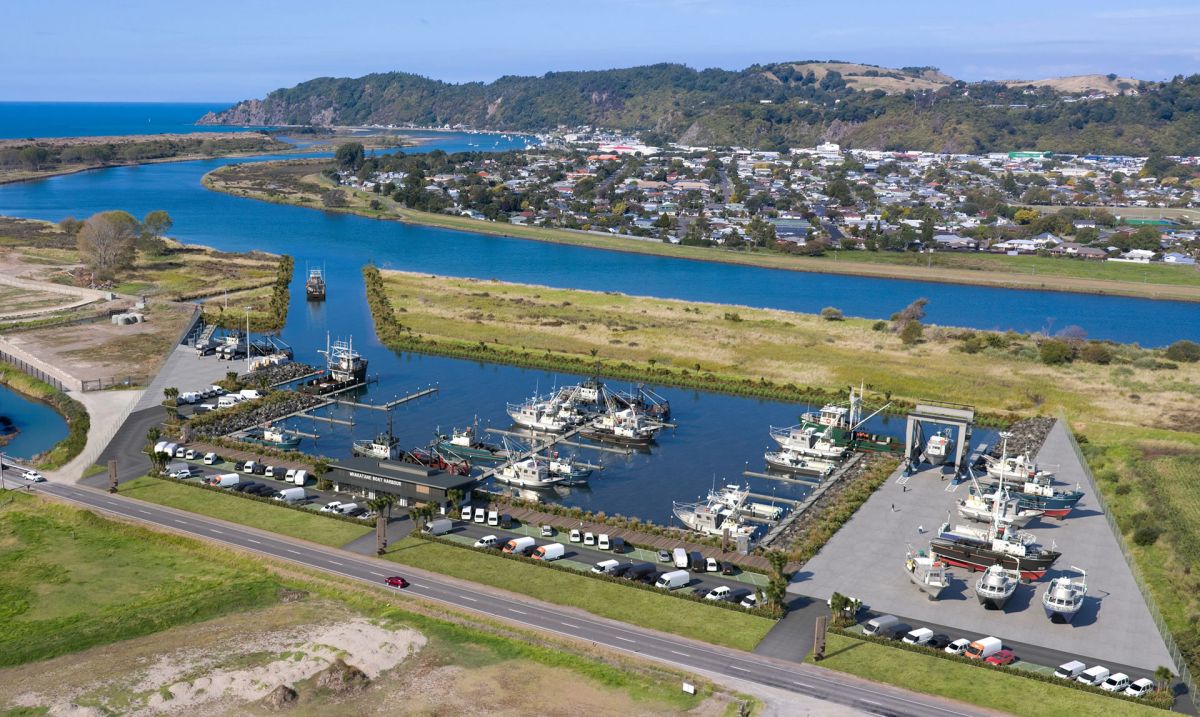
The marine school, to be sited at the new boat harbour, is a good example. We have some of the best aluminium boat builders in the world in the Whakatāne district. They have had to bring in skilled workers from overseas because of the lack of locals able to do the job. The new marine school will not only train local people for welding, but for all aspects of boat building and boat maintenance, from design to fit out. The boat harbour itself, coupled with highly skilled local people, will both draw and retain work in this local economy.

Whakatāne Boat Harbour - Artist's impression

As the work around the marine school and boat harbour shows, circularity in our local economy relies on long-term relationships between businesses, and between businesses and institutions. It is impossible to build a business ecosystem without some long-term commitment to shared goals of building collective local prosperity. I believe that most business owners in our sub-region do share that goal, but we lack the mechanisms to easily give effect to them.

This is why institutional commitments to a circular economy are important. During the COVID lockdown and recovery, and also with the Provincial Growth Fund, the Whakatāne District Council was able to attract far more Government money into this area than most councils of our size. Because this put a real strain on local contractors, the council worked with them and with other institutions to schedule work flows to keep them manageable, rather than swinging back and force like a pendulum. Contractors willingly took on temporary staff from other businesses facing a downturn, to help make sure local workers stayed employed. WDC was able to access Kia Kaha funding to keep work flowing, and its commitment to local employment saw 175 unemployed or redeployed people find work. 50 of those are now permanent jobs.

There are many elements of our local economy that are already circular, or at least moving towards it. The contribution of Māori world views, and Māori business, based on values such as whakapapa, kaitiakitanga, mana motuhake and intergenerational thinking will, I think, help move us even faster in that direction. I believe that it is where our community wants, and needs, to go to build a prosperous future where all people enjoy the benefits. Of course this is not something we can do alone. We need to build momentum in our individual businesses, in our business networks and in our local economy as a whole, as well as across the region, our nation, and the planet. When I look around at what is happening globally, I know we are not alone.

Published in the Whakatāne Beacon 30/12/20

Tagged ,

WHAT HAVE WE LEFT

I look at nature

the way that life pulses through it

the murmurations of birds

the running of inanga

and salmon

and herrings

and antelope

and bison

the inconceivable abundance

that powers this living planet

and all of the life upon it

and in it

and around it

and I worry

because we have pillaged it

despoiled it

ripped it apart

like clueless fucking idiots

and what have we left

for everyone else?

the bears

the wolves

the eagles and hawks

the whales and the orcas

all those beautiful

mesmerising

incredible

awesome beings

what have we left them?

or even left our own children?

are we really

that

stupid?

Why so interested in the US election?

I have been reflecting on why I paid so much attention to the US elections. As someone who is often critical of the US government, its history, its foreign and domestic policy, why do I feel so attached to the outcome? It’s not like there was anything really progressive on offer. What has it got to do with me, here in Aotearoa?

1. As a follower of Ras Tafari, I support multilateralism and strong international institutions that can make global decisions, protect weak nations from the strong through collective security, and at least encourage adherence to international law. Trump’s withdrawal from international forums has weakened our collective ability to act on things like climate change, pandemic and disarmament, and his ego-driven forays into international diplomacy have encouraged despots.

2. I feel great empathy for the people who have been suffering under his leadership – in particular the children who have been separated from their families at the US border, and inadequately documented and tracked. I fear for where they have ended up and shudder to think of the abuse and ill-treatment some of them may now be exposed to, as a direct consequence of his cruelty and callous indifference. But it does not end there. He has encouraged fascists and racists and violent intolerance and the US will be a more dangerous place for people of colour and for progressive activists for some time as a result.

3. I stand in solidarity with the many people in the US who are fighting to protect the environment from even more plundering by multinational corporations, in particular indigenous people. Trump’s scything through US environmental protections, like his mini-me Bolsonaro in Brazil, comes at a time when protection of ecological integrity is critical, and sucks energy that could be usefully used elsewhere.

4. At a time when the feminine principle is being restored to power, when re-finding the balance is so vital, it is deeply worrying that a man who openly boasts of his ability to sexually molest women with impunity can be so popular. I do not see how anyone can see such a man as fit to lead any nation at all.

5. While some will rejoice at the ruination of the US under Trump, its loss of international standing, the gaping wound now opened in its ‘democracy’ I fear a world where China is unrivaled for power. Trumps has hastened the already obvious demise of the US, under the ironic slogan of ‘Make America Great Again’, and I wonder where the counterbalances to Chinese power will come from. Having the US become a failed state does not help anyone I think.

Yeah, so I am glad that Trump lost. Convincingly, if not by the landslide it deserved.

Tagged ,

Weighing up the cannabis referendum – is the current law working?

When it comes to cannabis, I think most New Zealanders want more or less the same things.

We don’t want young people using cannabis. While the evidence is clear that most people use cannabis without problems, the few that do almost always started young and use heavily.

We want those people that do have drug problems to be helped rather than punished. Currently places in drug treatment services are hard to get, and almost non-existent outside of the main centres.

We don’t want to be wasting police time on arresting adults for simply enjoying cannabis. Freedom for adults to make their own decisions is a basic value, as long as they are not harming other people or putting other people at risk.

This September New Zealanders will get to vote on how best to achieve those outcomes. We can stick with how things are now, or move to a regulated market. The regulated model on offer is an improved version of Canada. It has a lot of carefully thought-through details so please do have a look at it. Consider both choices, to see which gets us closer to our goals. Have a look at what the independent research tells us about how best to manage cannabis.

When it comes to young people using cannabis, it has been normalised for decades. Cannabis is widespread and easy for young people to get hold. The Christchurch and Dunedin longitudinal studies at the University of Otago have given us some of the best evidence in the world around cannabis use. Their summary of the research can be found at cannabisreferendum.co.nz. They show that around 80% of New Zealanders have tried cannabis by age 25. While most people use cannabis without harm, a small number do experience problems. These are people who started young and use heavily.

We cannot stop young people using cannabis entirely, just as it is impossible to stop them drinking alcohol. We can make it more difficult for them to get hold of though. Having an age limit helps. In Canada, according to official Government figures,

“… use among Canadian youth has not increased. This accords with the Colorado experience—the first to legalize non-medical cannabis…. (while) use among 15- to 17-year-olds declined (19.8% to 10.4%).”

Statistics Canada

Being illegal means no controls, no age limit. It brings young people who do try cannabis into contact with a criminal underworld. Regulating the market by making it R20 won’t stop young people trying cannabis entirely, but it will make it harder for them to get into a pattern of risky use.

For the small number of people who do end up having problems with cannabis use, we need better drug education and drug treatment services. The economist Shamubeel Eaqub has estimated that we need another $150 million spent on drug treatment to meet current needs. The potential tax from cannabis sales (estimated at between $250 million to almost half a billion dollars) has been ring-fenced for drug harm reduction.

Finally, most people do not want to see their friends and neighbours being arrested for simply enjoying cannabis. We still arrest thousands of people a year for cannabis use in NZ, and there are even people in prison for growing their own. That is not usually any of the lawyers, doctors or accountants who enjoy cannabis. They rarely get searched by the police and if they do, get off with a warning. It is most likely to be someone poor and brown, for whom a cannabis conviction and fine can be life-destroying.

Arresting people for cannabis doesn’t stop them using it. In fact research shows that people are MORE likely to use it after being charged. The only people who the law inhibits from using cannabis, the only people for whom regular use goes up after legalisation, are the over-65’s. Perhaps this is because they now feel ok about trying it as a medicine for those aches and pains. Maybe it is because they have worked hard all their lives and deserve to enjoy a relatively benign recreational drug that makes them laugh.

And who could have a problem with that?

Tagged ,